Here's the reality most growing business owners face: your DIY bookkeeping system is breaking down, but hiring full-time staff feels like a massive financial commitment you're not ready for.
If you're like most small business owners hitting the $250K to $2M revenue mark, you're caught in that uncomfortable middle ground. Your spreadsheets and weekend bookkeeping sessions aren't cutting it anymore, but the thought of adding $60K+ in annual salary costs makes your stomach turn.
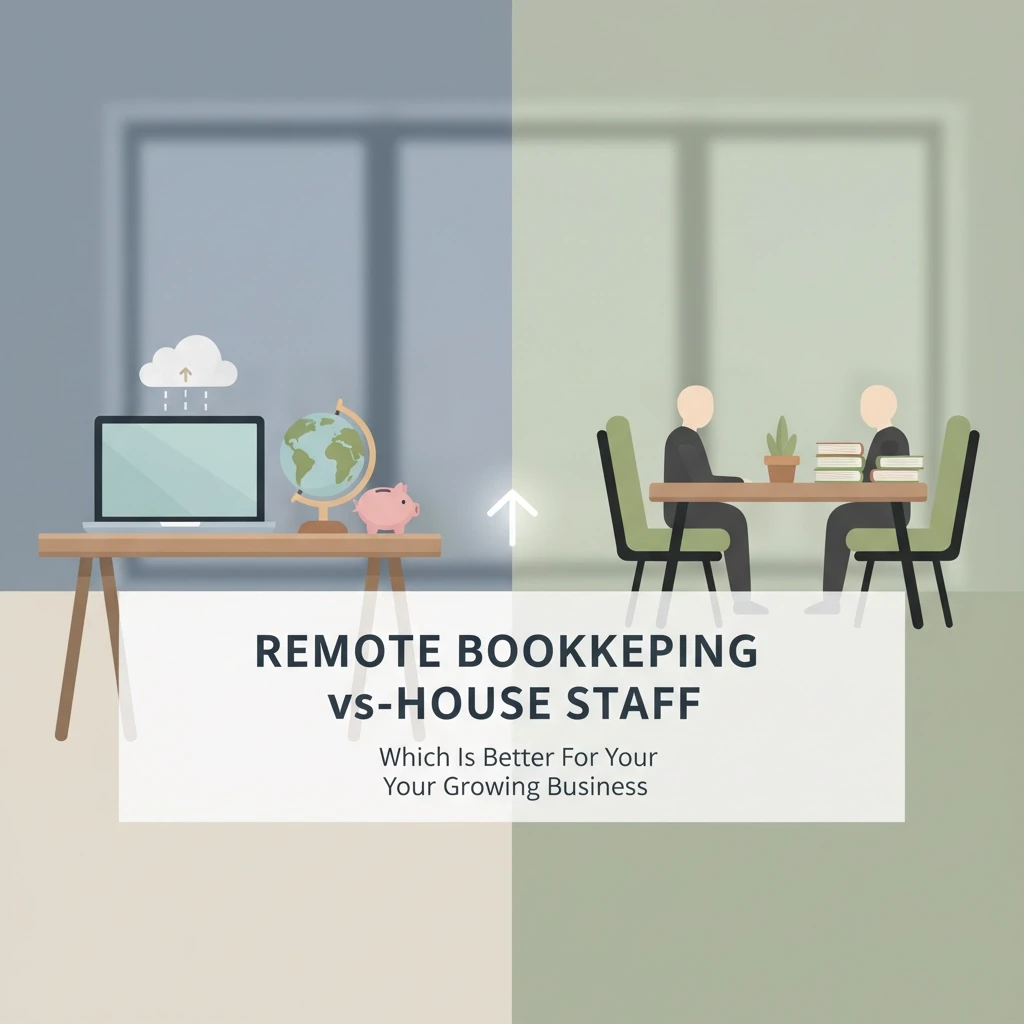
I've seen hundreds of businesses wrestle with this exact decision, and here's what the data tells us: remote bookkeeping delivers the same quality as in-house staff at 30-50% lower cost, while actually improving accuracy and reducing fraud risk. But that doesn't mean it's right for every business.
Let's break down exactly when each option makes sense for your growing company.
The Remote Bookkeeping Advantage: More Than Just Cost Savings
The numbers don't lie – outsourced bookkeeping typically runs $199-$1,500 per month compared to $4,500-$6,000 monthly for fully-loaded in-house staff. But the real advantages go far deeper than just saving money.
Superior Quality and Speed
Here's what surprises most business owners: remote bookkeeping firms actually deliver higher quality work than most in-house hires. The reason is simple – they're specialists who live and breathe bookkeeping all day, every day.
Businesses using outsourced bookkeeping close their monthly books in an average of 10 days versus 24 days for in-house operations. That's not a typo. Professional firms have streamlined processes, automated workflows, and dedicated teams that can process your books faster than a single employee juggling multiple responsibilities.
The accuracy improvement is equally impressive. Outsourced bookkeeping reduces accounting errors by 80% compared to non-specialist in-house staff due to standardized processes and built-in review systems.

Built-in Fraud Protection
This one keeps me up at night when I think about businesses handling everything in-house. Companies using outsourced services see 40-60% fewer instances of internal financial fraud because of proper separation of duties.
When your bookkeeper also handles bank deposits, writes checks, and reconciles accounts, you're creating the perfect storm for financial misconduct. Professional firms build controls into their processes that most small businesses would never think to implement.
Technology That Actually Works
Stop me if this sounds familiar: you're paying for QuickBooks, trying to integrate it with your payment processor, wrestling with payroll software that doesn't sync properly, and wondering why your reports never seem to match reality.
Remote bookkeeping firms include all of this in their service. The technology stack alone – including software subscriptions, integrations, and automation tools – would cost most businesses $200-$500 monthly to replicate independently.
Scalability Without the Hiring Headaches
As your transaction volume grows, you simply adjust your service package. No posting job listings, no interviewing candidates, no training new employees, and no worrying about what happens when someone quits right before tax season.
When In-House Staff Makes Sense
Don't get me wrong – in-house bookkeeping isn't wrong for every business. There are specific scenarios where having someone physically in your office provides genuine advantages.
Immediate Control and Communication
If your business requires constant, real-time collaboration on financial decisions, in-house staff gives you immediate access. You can walk over to their desk, ask quick questions, and get instant clarification on any transactions or reports.
This becomes especially valuable during busy periods like month-end close, tax preparation, or when you're preparing for investor meetings or loan applications.
Deep Business Integration
An in-house bookkeeper becomes intimately familiar with every aspect of your operations. They understand your business cycles, know your key customers, and can provide context that an outsourced firm might miss.
For businesses with highly complex, specialized operations or unique industry requirements, this deep integration can be worth the extra cost.

Multi-Role Flexibility
If your bookkeeping needs are relatively light, you can leverage in-house staff for other administrative tasks – HR support, office management, or customer service during slower periods.
The Real Cost Comparison (Prepare for Sticker Shock)
Let me break down the true cost of each option, because most business owners dramatically underestimate what in-house staff actually costs:
Remote Bookkeeping:
Monthly fee: $199-$1,500
Software: Included
Benefits: None required
Training: Included
Backup coverage: Included
Total monthly cost: $199-$1,500
In-House Bookkeeping:
Base salary: $35,000-$50,000 annually ($2,900-$4,200 monthly)
Benefits (health, dental, retirement): $500-$800 monthly
Payroll taxes: $250-$350 monthly
Software subscriptions: $200-$500 monthly
Training and development: $100-$200 monthly
Vacation/sick coverage: Varies
Total monthly cost: $3,950-$6,050
The difference? You're looking at 2-3x higher costs for in-house staff – and that's before factoring in the hidden costs of turnover, training, and coverage during absences.
The Hidden Risks Nobody Talks About
Single Point of Failure
Here's the scenario that terrifies me: your bookkeeper gets sick, takes vacation, or quits unexpectedly. Suddenly, your financial operations grind to a halt right when you need them most.
The average time to replace a qualified bookkeeper in today's market is 3-6 months. During that time, you're either scrambling to handle everything yourself or paying premium rates for temporary help.
Remote firms have teams and backup systems. If someone is unavailable, your work continues without interruption.
Limited Expertise
Unless you're hiring a senior-level professional (which costs significantly more), your in-house bookkeeper likely has gaps in their knowledge. Complex areas like multi-state tax compliance, investor reporting, or industry-specific requirements might be outside their wheelhouse.
Professional firms employ specialists across different areas and can bring the right expertise to your specific challenges.

Making the Right Choice for Your Business
Choose Remote Bookkeeping If:
Your revenue is between $250K-$5M annually
You want to minimize overhead while maintaining quality
You need access to advanced technology and automation
You operate in multiple states or have complex compliance needs
You prefer flexibility to scale up or down as needed
You want built-in fraud protection and quality controls
Choose In-House Staff If:
You require constant, immediate access to your bookkeeping team
Your business has highly specialized, unique accounting needs
You can comfortably budget $60K+ annually for a single role
You prefer direct control over all financial processes
Your operations are complex enough to justify dedicated headcount
Consider a Hybrid Approach If:
Your revenue exceeds $5M annually
You need strategic financial oversight beyond basic bookkeeping
You want the best of both worlds – professional expertise with on-site coordination
Quick Decision Framework
Ask yourself these three questions:
Can I afford $5,000+ monthly for bookkeeping without impacting growth investments? If no, remote bookkeeping is your answer.
Do I need immediate, real-time access to my bookkeeping team multiple times per day? If yes, consider in-house.
Would a bookkeeping mistake or fraud significantly damage my business? If yes, the built-in controls of professional firms provide crucial protection.
The Bottom Line
For most growing businesses, remote bookkeeping delivers superior value, quality, and protection at a fraction of the cost of in-house staff. The technology is proven, the quality controls are stronger, and the cost savings are substantial.
The businesses I see choosing in-house staff successfully are typically either very large (where the cost becomes relatively small) or have extremely specialized needs that require constant customization.
Don't let the fear of "losing control" prevent you from making the smart financial decision. Professional bookkeeping firms provide more transparency, better controls, and higher quality than most businesses can achieve internally.
Your energy is better spent growing your business than managing bookkeeping staff. Choose the option that frees you to focus on what you do best – and for most growing companies, that's professional remote bookkeeping.
Ready to explore outsourced bookkeeping for your business? The right firm can have you up and running within days, not months.
Related Reads for You
Discover more articles that align with your interests and keep exploring.